
Commercial Disinfection · DFW
Disinfection Services in Dallas–Fort Worth
Disinfection services only work on a surface that’s already clean and kept wet for the contact time the product label actually requires. For commercial facility managers and other decision-makers across Dallas–Fort Worth, that means professional cleaning followed by EPA-registered disinfectants applied to the right high-touch surfaces, with the work documented for your records, inspections, and day-to-day risk control. Most of what gets sold as disinfection in this market skips one or both. We don’t, and we write down what we did.
Digital Log Every Visit
Timestamped, emailed same night
Quality Verified
Quality verified by supervisor
Single Point of Contact
Named supervisor per facility, not a call center
Fully Insured
COI on request
100% Satisfaction Guarantee
Contact us within 24 hrs and we re-clean at no cost
In short:
Disinfection is the step that reduces or inactivates pathogens on a surface using an EPA-registered product held for its labeled contact time. It comes after cleaning, never instead of it, because soil shields germs from the chemical. For DFW workplaces, healthcare sites, schools, childcare centers, gyms, government buildings, and other shared environments, this page explains how the process should be done, what cleaning vs. sanitizing vs. disinfecting actually means, which surfaces and application methods make sense, how documentation and quality verification should work, and what facility-specific disinfection needs look like across the Metroplex. Craddock’s Cleaning Services disinfects high-touch surfaces, restrooms, and shared areas across Dallas–Fort Worth using disinfectants matched to the pathogen and surface, applied by hand or electrostatic sprayer, and recorded by area and chemical on every visit through our CleanProof system.
Clean, sanitize, disinfect: not the same job
These three get used as if they mean one thing. They don’t: cleaners should explain the difference between cleaning, sanitizing, and the disinfecting process, because standard cleaning is not the same job, and the order they run in is the part that matters.
Step one
Clean
Removes the dirt and grime that germs live in. It lowers the count but kills very little on its own, and it’s the step you can’t skip.
Step two
Sanitize
Knocks germs down to a level public health standards call safe, which is often enough for food-contact areas and shared surfaces where a full disinfection isn’t warranted.
Step three
Disinfect
Kills or inactivates the broader set of pathogens named on the product’s label. It only works on a surface that’s already clean, and only if the product stays wet for its full contact time. Skip either step and you’ve mostly moved things around.
A surface that looks clean can still carry what you’re trying to kill. And a disinfectant sprayed onto grime mostly disinfects the grime. Clean first, then disinfect. Every time. When the surface is properly cleaned and full contact time is met, the process can eliminate up to 99.999% of pathogens.
The important numbers
Contact time is the whole game
Every EPA-registered disinfectant has a contact time on its label, sometimes called dwell time. It’s the number of minutes the surface has to stay visibly wet for the product to make the kill claim on the bottle. Depending on the product, that’s usually one to ten minutes.
10 seconds ≠ disinfected
A spray-and-wipe in ten seconds doesn’t disinfect a surface, it just moves things around and evaporates. The surface looks done, but the claim on the label never happened.
Under federal pesticide law, those label directions are enforceable, which makes “we used the right product” and “we used it correctly” two different claims. Most of this market makes the first one. We hold the time, and we note that we held it. That’s what separates disinfecting from spraying.
What we disinfect
Disinfection is targeted work. It goes where hands go and where illness spreads, not blanket-sprayed across a room to look thorough. Routine disinfecting helps reduce the spread of bacteria and viruses in shared facilities.
- Door handles
- Push plates
- Rails
- Light switches & shared electronics
- Elevator buttons
- Restrooms & fixtures
- Break rooms & shared kitchens
- Locker rooms & wet areas
- Reception, counters, point-of-sale in offices and retail stores
- Shared equipment, workstations & high-touch areas
- Post-illness & outbreak response
Method
How we apply it, Correctly
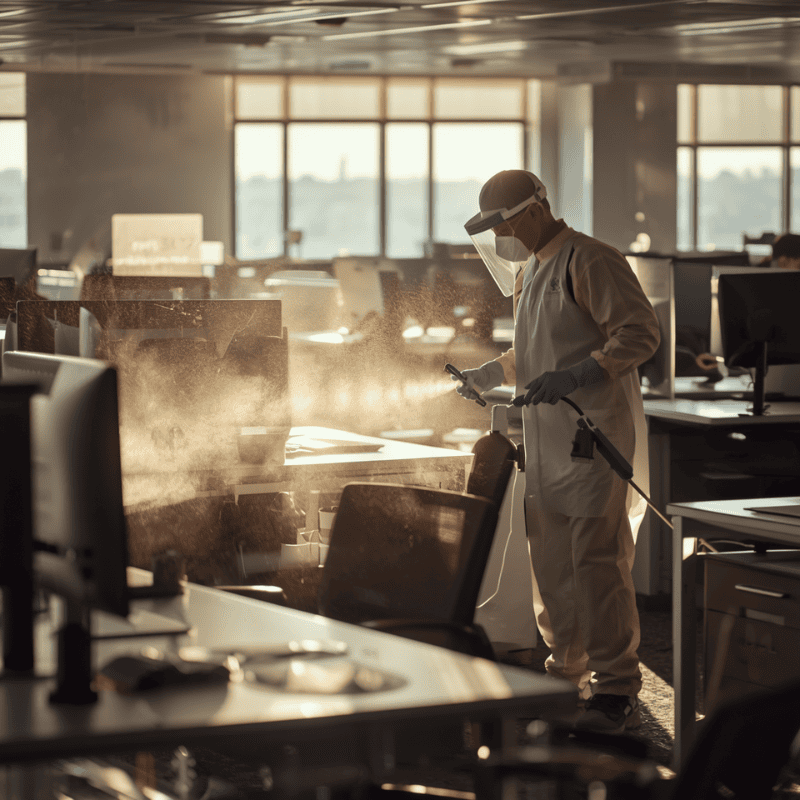
Two rules come before any equipment: clean the surface first, and hold the contact time. Everything else is just how the disinfectant gets there, with our technicians wearing appropriate personal protective equipment during application. We match the method to the surface and the facility’s specific needs.
How we work
- Hand application by trained technicians on the high-touch surfaces people actually touch, where targeting beats coverage
- Electrostatic application for even coverage on complex or large areas, where charged droplets coat sides and undersides a wipe can miss. Our team may employ different methods depending on the surface and layout. It follows cleaning and still holds contact time
- Chemistry matched to the job, including hydrogen-peroxide-based products where the surface and pathogen call for it
What we won’t do
- Fog an occupied room and call the building clean. Disinfecting fogging disperses a fine mist throughout a room, but coverage alone is not cleaning or verified disinfection, and when used for a defined application it should rely on epa approved disinfectants rather than be treated as a shortcut
- Print “kills 99.9%” as a slogan. The real claim is whatever the chosen product’s label supports against the pathogen you’re worried about
- Disinfect over soil to save a step, which mostly wastes the chemical
The right product for the pathogen you have
It’s EPA-registered, not EPA-approved. The EPA registers antimicrobial products under federal pesticide law, and the label’s kill claims are the part that’s enforceable; the disinfectants used also need to comply with OSHA and EPA requirements for safety. So we match the product to the target: the agency keeps separate lists for separate pathogens, and the COVID-19 list, known as List N, is specific to that virus rather than a general-purpose credential the way it often gets used.
We also skip “hospital-grade.” It isn’t a regulated term, which is exactly why everyone reaches for it. What we’ll tell you instead is the product we’re using and what its label supports for your situation. Some botanical disinfectants carry label claims to kill over 99.99% of bacteria in 30 seconds. If a surface needs a product effective against staph and MRSA, we use one registered for it and hold its time.
Documentation you can hand to an inspector
Every disinfection visit produces a digital log: the area covered, the product used, and confirmation that contact time was observed. It goes out the same night through CleanProof, helping protect the facility during audits or inspections.
For a regulated facility, that record is the whole point. A licensed child-care center in Texas has to keep a written housekeeping and cleaning routine. A school, a healthcare admin office, a government building all answer to a sanitation standard, and those records help safeguard employees and customers in regulated spaces. The log is the difference between telling an inspector you disinfect and showing them when, where, and with what.
Where it matters most
Facilities we disinfect across DFW
Disinfection carries the most weight where people are close together, sharing surfaces, or more vulnerable to what’s on them.
Medical & healthcare
Waiting rooms, exam surfaces, and non-critical shared items, cleaned and low-level disinfected within a defined scope, helping protect patients, staff, and the broader environment through routine healthcare disinfection.
Daycare & child care
High-touch toys, tables, and restrooms under Texas child-care housekeeping requirements. These routines help protect children, staff, and families.
Schools & universities
Classrooms, shared devices, and locker areas, with outbreak response when a bug moves through.
Gyms & fitness centers
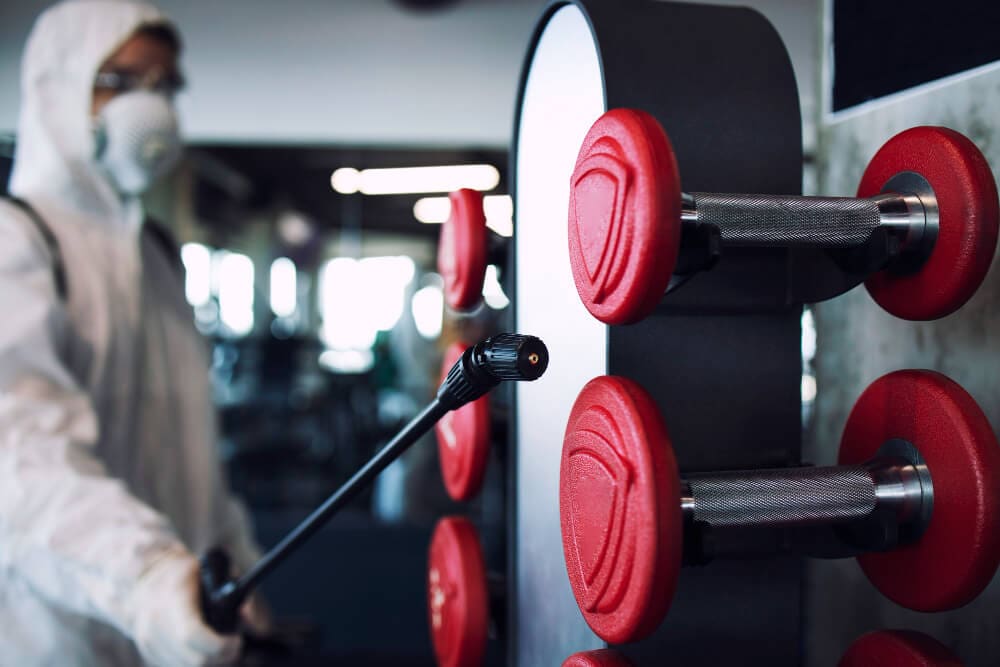
Skin-contact equipment and locker rooms, held to label contact time.
Office buildings
Shared kitchens, bathrooms, conference rooms, and other high-traffic surfaces touched by employees and visitors.
Government facilities
Public-facing counters and shared workspaces on a documented schedule.
Disinfection works best built into the routine
Most people call about disinfection after something has already spread. We’ll do the one-time visit, but the version that actually protects a building is disinfection built into the regular janitorial program, so the cleaning that has to come first is already happening on a schedule. Antimicrobial coatings can help between visits, but they should complement regular cleaning and disinfection, not replace them. That approach helps with maintaining a cleaner, safer facility over time.
Handled by the same crew that cleans the building, the chemistry stays consistent and the documentation stays in one place. It also pairs with deep cleaning for a reset, and with medical equipment cleaning where non-critical patient-care items need it.
Our disinfection related services
Our commercial cleaning services is a cornerstone in the prevention of infection outbreak, and step 1 in case of confirmed outbreak.
After cleaning, a deep clean is both a periodic cleaning measure to prevent infection and a necessary step 2 in case of a confirmed outbreak.
A significant pillar in keeping a healthy environment and prevent infection spread.
Periodic carpet deep cleaning and dirt extraction can prevent outbreak of an infection.
Tell us what your disinfection needs are
Whether it’s a standing schedule or a response to something that already spread, tell us the facility and the concern. We’ll match the product to the pathogen, hold the contact time, and hand you the record.
100% satisfaction guarantee: not happy with the work, we re-clean at no extra cost. Call within 24 hours of the visit to qualify.
Questions we get